
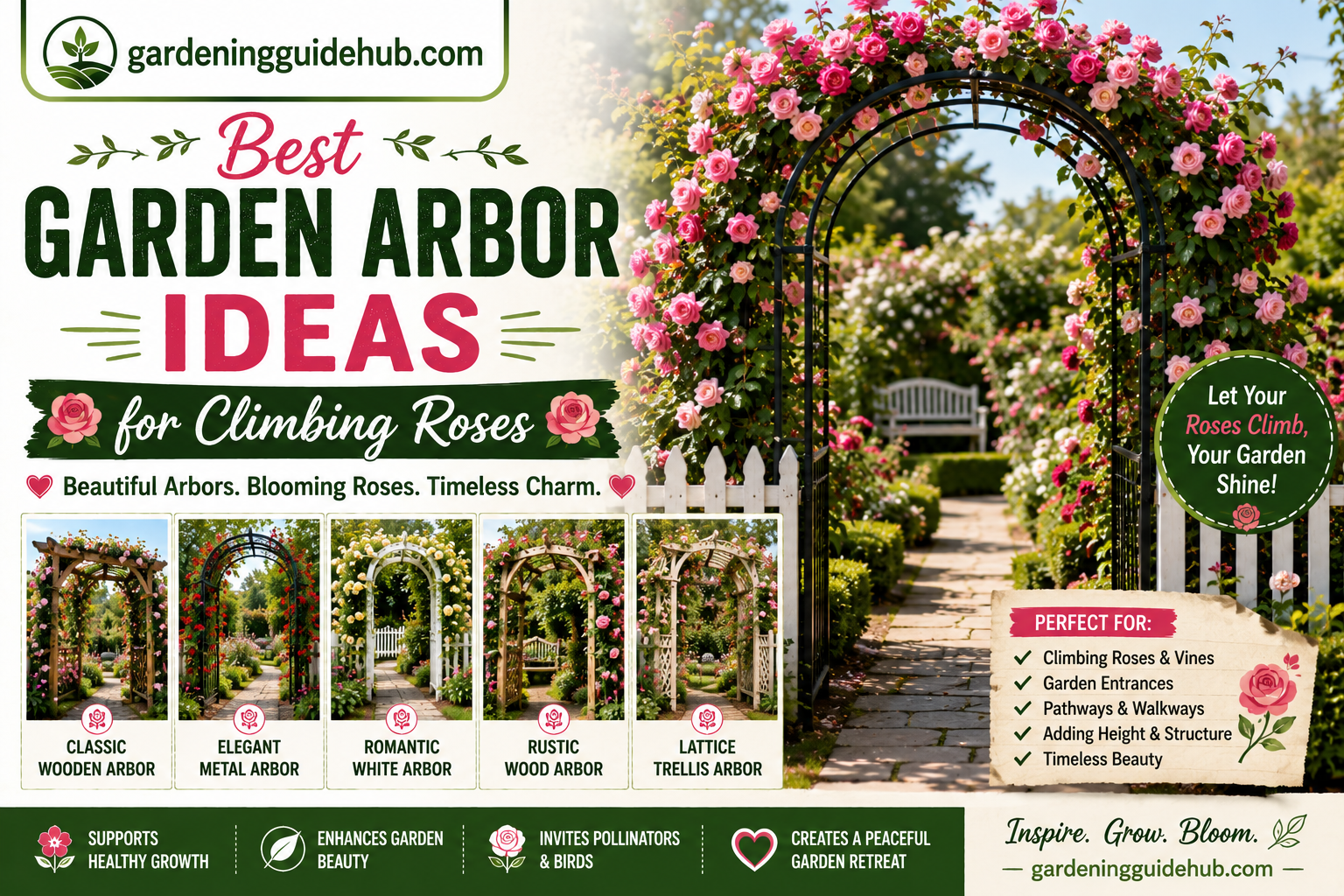
There are few garden pairings as timelessly romantic as a wooden arbor dripping in climbing roses. That soft cascade of blooms, the gentle fragrance drifting through the air, the way morning light filters through the petals, it is the kind of scene that makes an entire garden feel like something out of a storybook. If you have been dreaming of creating that look in your own backyard, you are in exactly the right place.
Choosing the right arbor style and pairing it with the right rose variety makes all the difference between a structure that looks a little sparse and one that looks like it has been growing there for decades. This guide will walk you through the best arbor styles, ideal rose varieties, placement tips, and care advice so your climbing roses have everything they need to truly flourish. Let us dig in. 🌸
Why Arbors and Climbing Roses Are Such a Perfect Match 💛
Before exploring specific ideas, let us talk about why this particular combination has remained a garden classic for generations.
Reasons this pairing works so beautifully:
- Arbors provide the vertical structure climbing roses need to grow upward rather than sprawling
- The combination creates a natural focal point, drawing the eye through the garden
- Roses trained over an arbor create a living, fragrant doorway or transition point
- The structure supports heavy blooms that would otherwise flop or break under their own weight
- Over time, mature roses and a weathered arbor create an established, romantic garden feel
An arbor without roses can feel a little bare, and roses without support tend to sprawl untidily, but together, they create something far more beautiful than either could achieve alone.
Quick Comparison: Popular Arbor Styles 📊
Here is a simple table comparing some of the most popular arbor styles for supporting climbing roses.
| Style | Material | Best For | Approximate Cost |
|---|---|---|---|
| Classic wooden arbor 🪵 | Cedar, redwood | Traditional garden entrances | $150 to $500 |
| Metal garden arbor ⚙️ | Wrought iron, steel | Elegant, romantic gardens | $200 to $600 |
| Flat top arbor ⬛ | Wood or metal | Modern or minimalist yards | $150 to $450 |
| Peaked cottage arbor 🏠 | Wood | Cottage or farmhouse gardens | $180 to $500 |
| Double arbor walkway 🌈 | Wood or metal | Creating a rose covered tunnel | $400 to $1,200 |
| Rustic branch arbor 🌾 | Natural wood branches | Woodland or informal gardens | $50 to $200 |
Choosing a style that matches your garden’s overall personality helps the arbor feel like a natural, intentional feature rather than an afterthought.
Choosing the Right Climbing Rose Variety 🌹
Not all climbing roses are created equal, and choosing the right variety for your specific arbor and climate makes a huge difference in how well the pairing performs.
Popular climbing rose varieties:
| Variety | Color | Bloom Habit | Fragrance |
|---|---|---|---|
| New Dawn 🌸 | Soft pink | Repeat blooming | Light, sweet |
| Climbing Iceberg ⚪ | Pure white | Heavy repeat blooming | Mild |
| Zephirine Drouhin 💗 | Deep pink | Repeat blooming, thornless | Strong and sweet |
| Golden Showers 💛 | Bright yellow | Repeat blooming | Moderate |
| William Baffin ❤️ | Deep pink to red | Very hardy, repeat blooming | Light |
| Cecile Brunner 🌷 | Soft pink | Small clustered blooms | Light |
If you have small children or pets who frequently pass near the arbor, Zephirine Drouhin is a particularly popular choice thanks to its nearly thornless canes, making it far friendlier to brush past than most other varieties.
Step One: Choosing the Right Location 📍
Placement plays a huge role in how well both your arbor and your roses will perform over time.
Key factors to consider:
- Sunlight, since climbing roses generally need at least six hours of direct sun daily to bloom well
- Airflow, avoiding overly enclosed spots that can encourage fungal issues like black spot
- Soil quality, ensuring good drainage and rich, fertile soil at the base of the arbor
- Visibility, positioning the arbor somewhere it can be admired, such as a garden entrance or pathway transition
- Structural support, making sure the arbor is sturdy enough to handle the eventual weight of mature rose canes
A south facing or west facing location often provides the ideal balance of sunlight for most climbing rose varieties, though always check your specific variety’s preferences.
Step Two: Installing a Sturdy Arbor 🔨
Since climbing roses can become quite heavy once fully mature, starting with a sturdy, well anchored arbor is essential.
Installation tips:
- Set posts in concrete for maximum stability, especially for wooden arbors that will bear significant weight over time
- Choose pressure treated or naturally rot resistant wood, such as cedar, for ground contact posts
- Ensure the arbor is wide enough to comfortably walk through, typically at least three to four feet
- Double check that all joints and connections are securely fastened, since a wobbly structure will only worsen as roses add weight
If you are purchasing a pre made arbor rather than building one, look for reinforced joints and thicker gauge materials, since budget options sometimes struggle under the weight of a fully mature climbing rose.
Step Three: Planting Your Climbing Roses 🌱
Proper planting technique sets your roses up for healthy, vigorous growth right from the start.
Planting steps:
- Dig a hole roughly eighteen inches deep and wide at the base of your arbor
- Mix compost or aged manure into the native soil to improve fertility and drainage
- Position the rose so the graft union sits at or slightly below soil level, depending on your climate
- Backfill gently, watering thoroughly to settle the soil around the roots
- Space multiple roses at least three feet apart if planting more than one per arbor side
Planting roses about six inches away from the arbor’s base, rather than directly against it, allows better airflow and easier access for future training and pruning.
Step Four: Training Roses to Climb 🌿
Climbing roses do not naturally cling to structures the way vines do, so a bit of hands on training is necessary to guide their growth along your arbor.
Training tips:
- Gently weave new canes through the arbor’s framework as they grow, securing loosely with soft garden twine
- Train canes horizontally when possible, since this encourages more flowering side shoots than purely vertical growth
- Avoid tying canes too tightly, leaving room for the stems to thicken naturally over time
- Continue training throughout the growing season, checking every couple of weeks during active growth periods
This gentle guidance in the early years pays off enormously, resulting in a fuller, more evenly covered arbor once the rose matures.
Step Five: Ongoing Care and Maintenance 🌸
Once established, climbing roses require some regular care to stay healthy, vigorous, and full of blooms.
Care checklist:
| Task | Frequency | Purpose |
|---|---|---|
| Watering 💧 | Weekly, deeply | Encourages strong root development |
| Fertilizing 🌿 | Every 4 to 6 weeks during growing season | Supports healthy blooms and growth |
| Pruning ✂️ | Annually, typically late winter | Removes dead wood, shapes growth |
| Deadheading 🌸 | Throughout blooming season | Encourages continued flowering |
| Pest monitoring 🐛 | Regularly | Catches aphids or black spot early |
Most climbing roses benefit from a more substantial pruning once a year, ideally in late winter or very early spring before new growth begins, removing dead or damaged canes and lightly shaping the overall structure.
Common Pests and Problems to Watch For 🐛
Even healthy climbing roses can occasionally run into a few common issues, so knowing what to watch for helps you catch problems early.
Frequent issues:
- Aphids, which cluster on new growth and can be treated with insecticidal soap
- Black spot, a fungal disease causing dark spots on leaves, often worsened by poor airflow
- Powdery mildew, appearing as a white, dusty coating, usually linked to humid conditions
- Japanese beetles, which can quickly skeletonize leaves and damage blooms
Choosing disease resistant varieties from the start, along with ensuring good airflow around your arbor, significantly reduces how often these issues become a serious problem.
Styling Ideas to Complement Your Rose Covered Arbor 🎨
Once your arbor and roses are thriving, a few additional touches can elevate the entire scene even further.
Styling ideas to consider:
- Underplant the base with lavender or catmint for complementary color and fragrance
- Add a small bench nearby to enjoy the view and fragrance up close
- Install a soft garden light near the arbor to highlight blooms during evening hours
- Pair with a gravel or stone pathway leading through the arbor for a polished, finished look
- Include a matching trellis or fence section nearby for a cohesive garden design
Quick pairing table for arbor surroundings:
| Element | Effect | Notes |
|---|---|---|
| Lavender border 💜 | Complementary color and scent | Also attracts pollinators |
| Garden bench 🪑 | Inviting spot to enjoy the view | Choose weather resistant materials |
| Soft lighting 💡 | Highlights blooms in the evening | Warm toned bulbs work best |
| Stone pathway 🪨 | Polished, finished approach | Defines the walking path clearly |
These small additions help the arbor feel like a fully realized garden feature rather than an isolated structure standing alone.
Common Mistakes to Avoid ⚠️
Even experienced gardeners can run into a few avoidable issues when pairing arbors with climbing roses.
- Choosing an arbor that is too flimsy to support a mature rose’s eventual weight
- Planting roses too close to the arbor’s base, restricting airflow and future access
- Skipping regular training in the early years, resulting in uneven, sparse coverage
- Ignoring pruning, which can lead to a tangled, overgrown mess over time
- Choosing a rose variety unsuited to your specific climate or sunlight conditions
Taking the time to plan thoughtfully from the very beginning leads to a far more beautiful, manageable result once your roses reach full maturity.
Final Thoughts 🌼
A garden arbor covered in climbing roses is one of those classic garden features that only becomes more beautiful with time. With a sturdy structure, the right rose variety for your climate, and a little patient training and care in the early years, you can create a genuinely stunning focal point that draws the eye and fills the air with fragrance for years to come.
So choose your arbor style, pick a rose variety that speaks to you, and start planting. In just a season or two, you will have your very own romantic, rose covered entryway, the kind of garden feature that makes an entire yard feel like something truly special.
Happy planting! 🌹🌿
This was a helpful take on best garden arbor ideas for climbing. We keep seeing the same pattern: people rush to plant shopping and skip the measuring and sun-mapping stage, then struggle later. Your photos make the process easy to follow. Bookmarking this one.