
You have built your raised bed, picked the perfect sunny spot, and now you are staring at an empty wooden box wondering one very important question. How much soil do you actually need to fill it?
This is one of the most common questions beginner gardeners ask, and honestly, it trips up experienced gardeners too. Buy too little soil and you will make multiple frustrating trips to the store. Buy too much and you are left with bags of leftover dirt taking up space in your garage.
In this guide, you will learn exactly how to calculate the right amount of soil for your raised bed, understand the best soil mix ratios, and avoid the common mistakes that lead to wasted money and wasted trips. Let’s break down the math in a way that actually makes sense. 🧮
📐 The Simple Formula for Calculating Soil Volume
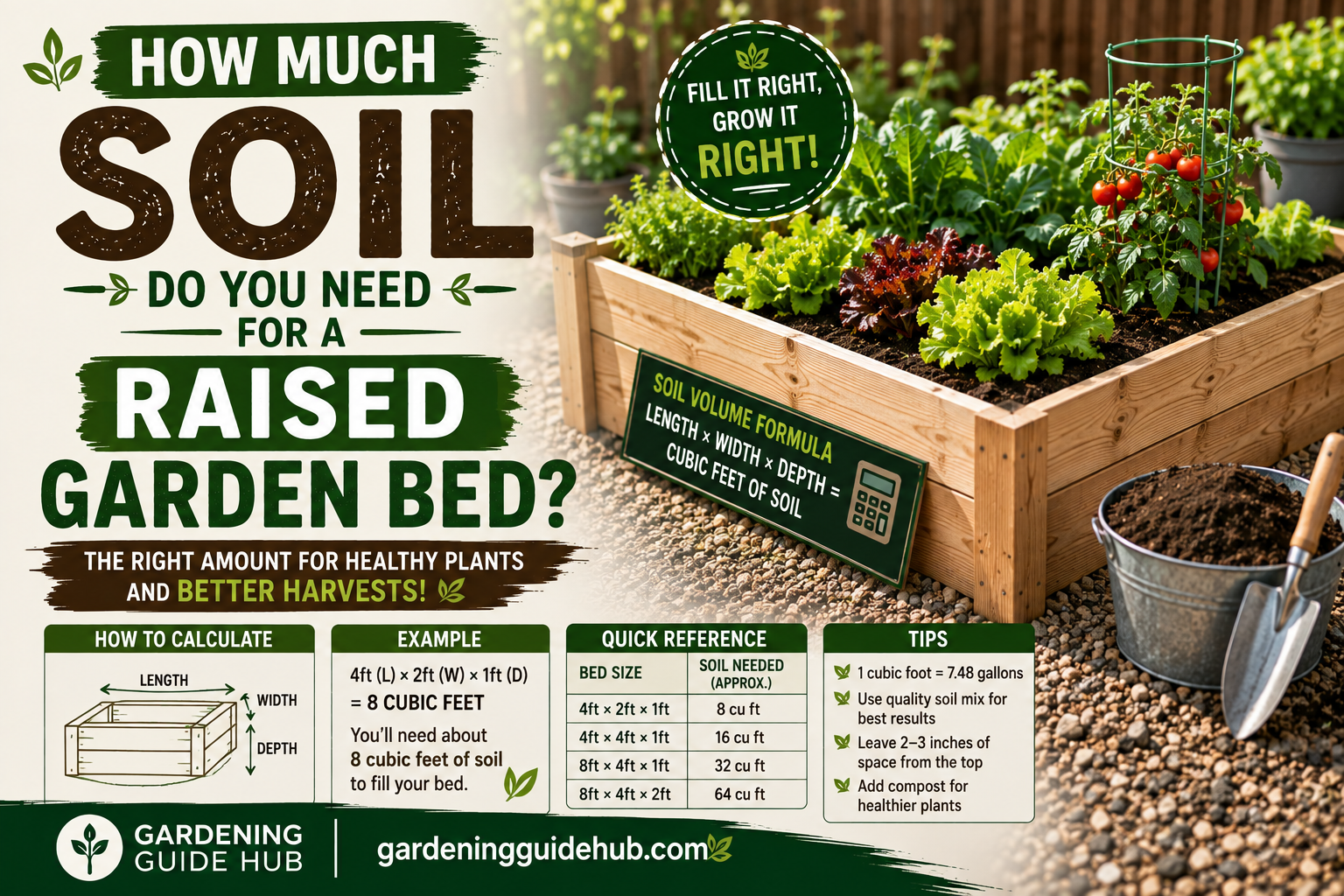
Calculating how much soil you need comes down to one basic formula.
Length x Width x Height = Total Volume
This gives you the volume in cubic feet, assuming you measure all three dimensions in feet. If your bed is 4 feet long, 3 feet wide, and 1 foot tall, the math looks like this.
4 x 3 x 1 = 12 cubic feet of soil needed
That is really all there is to it. The tricky part is usually converting cubic feet into the units that stores actually sell soil in, which we will cover in the next section.
📊 Soil Needed by Common Raised Bed Sizes
To save you from doing the math yourself, here is a table with some of the most common raised bed dimensions and how much soil each one requires at a standard 12 inch depth.
| Bed Size (Length x Width) | Height | Soil Needed (Cubic Feet) | Soil Needed (Cubic Yards) |
|---|---|---|---|
| 2 x 2 feet | 12 inches | 4 cubic feet | 0.15 cubic yards |
| 3 x 3 feet | 12 inches | 9 cubic feet | 0.33 cubic yards |
| 4 x 4 feet | 12 inches | 16 cubic feet | 0.59 cubic yards |
| 4 x 6 feet | 12 inches | 24 cubic feet | 0.89 cubic yards |
| 4 x 8 feet | 12 inches | 32 cubic feet | 1.19 cubic yards |
| 6 x 8 feet | 12 inches | 48 cubic feet | 1.78 cubic yards |
If your bed is a different depth, simply multiply your bed’s square footage (length times width) by the height in feet to get your total cubic feet.
📏 Understanding Cubic Feet vs Cubic Yards vs Bags
Soil is sold in a few different units depending on where you shop, so it helps to understand how they relate to each other.
- 🛍️ Bagged soil: Usually sold in 1 or 1.5 cubic foot bags at garden centers and hardware stores
- 📦 Bulk cubic feet: Some suppliers sell soil by the cubic foot for smaller orders
- 🚛 Bulk cubic yards: Larger suppliers and landscaping companies sell soil by the cubic yard, which equals 27 cubic feet
Quick Conversion Table
| Unit | Equivalent |
|---|---|
| 1 cubic yard | 27 cubic feet |
| 1 cubic yard | Roughly 18 standard 1.5 cubic foot bags |
| 1 cubic foot | About 7.5 gallons of soil |
For small beds, buying bagged soil is usually more convenient. For larger beds or multiple beds, ordering soil in bulk by the cubic yard almost always saves money.
🧮 Step by Step: Calculating Soil for Your Own Bed
Follow these steps to figure out exactly how much soil your specific raised bed needs.
- Measure the length of your bed in feet.
- Measure the width of your bed in feet.
- Measure the height or depth of your bed in feet (12 inches equals 1 foot).
- Multiply length by width by height to get cubic feet.
- Divide that number by 27 if you want the total in cubic yards.
- Divide cubic feet by 1.5 if you plan to buy standard bagged soil, since most bags contain 1.5 cubic feet.
Example: A bed measuring 4 feet by 8 feet with a height of 1.5 feet would need 4 x 8 x 1.5, which equals 48 cubic feet, or about 32 standard bags of soil.
🌱 What Should Your Soil Mix Actually Contain?
Filling your raised bed with pure topsoil is not the best approach. A blended mix gives your vegetables and flowers the nutrients, drainage, and structure they need to truly thrive.
A widely recommended soil mix ratio for raised beds includes the following.
| Ingredient | Purpose | Suggested Ratio |
|---|---|---|
| 🍂 Compost | Adds nutrients and organic matter | 40 percent |
| 🌍 Topsoil | Provides structure and minerals | 40 percent |
| 🪨 Perlite, vermiculite, or coarse sand | Improves drainage and aeration | 20 percent |
Some gardeners also use a method called the lasagna or hugelkultur approach, layering organic materials like logs, straw, and leaves at the bottom of deep beds to reduce the total amount of purchased soil needed while improving long term soil health.
🪵 Filling Deep Beds Without Overspending
If you have built a particularly deep raised bed, filling it entirely with premium soil and compost can get expensive fast. Thankfully, there are smart ways to reduce costs without sacrificing plant health.
- 🪵 Add a layer of logs or branches at the bottom: This is the foundation of the hugelkultur method and slowly breaks down to feed your soil over time
- 🍂 Use straw or leaf litter as a filler layer: These materials decompose and improve soil structure while taking up space that would otherwise require purchased soil
- 🧱 Fill the bottom third with cardboard and yard waste: This is especially useful for extremely deep beds where roots will not reach the very bottom anyway
- 🌾 Reserve your best compost and topsoil mix for the top 12 inches: Since most vegetable roots stay within this zone, this is where quality soil matters most
This layering approach not only saves money but also improves drainage and encourages beneficial microbial activity as the buried organic material breaks down.
💰 Estimating the Cost of Filling Your Raised Bed
Soil costs vary widely depending on quality, location, and whether you buy in bags or bulk. Here is a rough estimate to help you budget.
| Bed Size | Bagged Soil Cost | Bulk Soil Cost |
|---|---|---|
| 3 x 3 feet | 25 to 45 dollars | 20 to 35 dollars |
| 4 x 4 feet | 45 to 75 dollars | 35 to 55 dollars |
| 4 x 8 feet | 90 to 150 dollars | 60 to 100 dollars |
| 6 x 8 feet | 135 to 225 dollars | 90 to 150 dollars |
As you can see, bulk soil almost always comes out cheaper for larger beds, though it typically requires a delivery minimum and a place to dump a large pile, which is not always practical for small yards.
🛒 Bagged Soil vs Bulk Soil: Which Should You Choose?
| Factor | Bagged Soil | Bulk Soil |
|---|---|---|
| 💰 Cost per cubic foot | Higher | Lower |
| 🚚 Delivery | Not usually needed | Often required for larger orders |
| 🧳 Convenience | Very convenient for small beds | Requires space to store or dump |
| 🎯 Precision | Easy to measure exact amounts | Slightly harder to measure precisely |
| 🏡 Best for | Small beds or apartment gardens | Large beds or multiple beds |
If you are filling just one or two small beds, bagged soil is usually the simpler choice despite the higher per unit cost. If you are filling several beds or one very large bed, bulk soil delivery will likely save you a significant amount of money.
📐 Calculating Soil for Irregular Shaped Beds
Not every raised bed is a perfect rectangle. If you built an L shaped, circular, or otherwise irregular bed, the basic formula needs a small adjustment.
For L shaped or corner beds: Break the shape into two or more rectangles, calculate the volume of each section separately, then add the totals together.
For circular beds: Use the formula for the volume of a cylinder, which is pi (3.14) multiplied by the radius squared, multiplied by the height. For example, a circular bed with a 3 foot radius and a 1 foot height would need 3.14 x 3 x 3 x 1, which equals roughly 28 cubic feet of soil.
For raised beds with sloped or tapered sides: Measure the average width across the top and bottom of the bed, then use that average in your standard length times width times height calculation for a reasonably accurate estimate.
While these calculations are not perfectly exact for oddly shaped beds, they get you close enough to avoid major over or under buying.
⚖️ Understanding Soil Weight
Soil is heavier than most people expect, which matters if you are transporting it yourself or placing a raised bed on a deck or balcony that has weight restrictions.
| Soil Type | Approximate Weight per Cubic Foot |
|---|---|
| 🌍 Dry topsoil | 40 to 45 pounds |
| 💧 Moist topsoil | 75 to 100 pounds |
| 🍂 Compost | 30 to 50 pounds |
| 🪨 Perlite or vermiculite | 5 to 10 pounds |
A medium sized 4 by 4 foot bed filled to 12 inches deep could weigh well over 600 pounds once fully watered. If you are placing your raised bed on an elevated deck, balcony, or rooftop, it is worth checking the structure’s weight capacity before filling it completely, especially with denser soil mixes.
🌿 Choosing a Quality Soil Supplier
Not all soil is created equal, and where you source it can make a real difference in how well your vegetables grow.
Things to look for in a good soil supplier:
- Ask whether the compost has been properly aged, since fresh, unfinished compost can actually harm young plants
- Look for a dark, crumbly texture rather than heavy clay or overly sandy soil
- Choose suppliers who test their soil for contaminants, especially if sourcing from urban or industrial areas
- Avoid soil with a strong sour or ammonia like smell, which can indicate poor composting
- Ask local gardening groups or nurseries for supplier recommendations in your area
Spending a little extra time researching your soil source pays off enormously once your vegetables start growing, since healthy soil is the foundation of a healthy harvest.
🌦️ How Climate Affects Your Soil Needs
Your local climate can influence both how much soil you need and how often you will need to replenish it.
- ☀️ Hot, dry climates: Soil breaks down and compacts faster due to intense sun exposure, often requiring more frequent top offs
- 🌧️ Wet, rainy climates: Heavy rainfall can wash away nutrients faster, so adding compost more regularly helps maintain fertility
- ❄️ Cold climates: Freeze and thaw cycles can cause soil to settle more noticeably, so expect to top off beds each spring
- 🌤️ Mild, temperate climates: Generally require the least frequent soil replenishment, though annual compost additions are still recommended
Understanding your regional climate helps you plan not just your initial soil purchase, but your long term maintenance routine as well.
⚠️ Common Mistakes When Estimating Soil
- 🚫 Forgetting to account for soil settling, which can reduce volume by 10 to 20 percent over the first few weeks
- 🚫 Measuring in inches but forgetting to convert to feet before calculating volume
- 🚫 Filling the entire bed with topsoil alone, which lacks the nutrients vegetables need
- 🚫 Underestimating how much soil deep beds require, leading to multiple extra trips
- 🚫 Buying low quality fill dirt instead of a proper garden soil blend
- 🚫 Not leaving room near the top of the bed for mulch or watering space
🔁 Refilling Your Bed Each Season
Soil in raised beds naturally compacts and loses volume over time as organic matter breaks down and nutrients are used up by growing plants. Most gardeners need to top off their beds every season rather than doing a full refill.
A simple yearly maintenance routine:
- Add a one to two inch layer of fresh compost at the start of each growing season.
- Gently mix the new compost into the top few inches of existing soil.
- Check soil level and top off with additional soil if it has dropped noticeably below the rim.
- Rotate crops to help maintain balanced nutrient levels naturally.
This routine keeps your raised bed productive for years without requiring a full soil replacement.
❓ Frequently Asked Questions
| Question | Answer |
|---|---|
| How deep should soil be in a raised bed? | Most vegetables do well with 10 to 12 inches, though root vegetables prefer 14 to 18 inches |
| Can I use garden soil straight from my yard? | It is best to blend native soil with compost rather than using it alone |
| How often do I need to add new soil? | Most beds need a top off with fresh compost once or twice per year |
| Is bulk soil cheaper than bagged soil? | Yes, especially for beds larger than about 4 by 4 feet |
| Does soil volume shrink over time? | Yes, expect settling of around 10 to 20 percent in the weeks after filling |
🌟 Final Thoughts
Figuring out how much soil you need for a raised garden bed does not have to be a guessing game. With a simple formula, a bit of measuring, and a smart soil mix, you can fill your bed with confidence and avoid unnecessary trips to the store or wasted money on excess soil.
Take the time to measure carefully, choose a quality soil blend, and remember that a little top off each season keeps your raised bed thriving for years to come. Now that the math is out of the way, it is time to get your hands dirty and start planting.
Happy gardening! 🌱🪴🍅