Winter has a way of putting a pause on most outdoor projects, and composting is often one of the first things gardeners give up on when the temperature drops. Piles freeze, turning becomes a chore nobody wants to do in the snow, and the whole process seems to grind to a halt. But here’s the good news: it doesn’t have to be that way. 🌱
If you’ve ever wondered whether it’s actually possible to keep composting through the cold months, the short answer is yes, and a compost tumbler is one of the smartest tools for making it happen. In this guide, we’ll walk through exactly why tumblers outperform traditional piles in winter, how they work, and what you can do to get the best results even when it’s freezing outside.
🌡️ Why Composting Gets Harder in Winter
Before diving into why tumblers are so effective, it helps to understand what actually goes wrong with composting once the weather turns cold.
Composting is essentially a biological process. Bacteria and fungi break down organic material, and that activity produces heat as a byproduct. Warmth keeps those microbes active, and active microbes keep the whole system moving. When outdoor temperatures fall, the heat inside a compost pile can escape faster than it’s generated, especially in an open pile with no protection from wind and cold.
Once the internal temperature of your compost drops too low, microbial activity slows dramatically or stops altogether. That means your food scraps, leaves, and garden waste just sit there instead of breaking down. For gardeners hoping to have finished compost ready in spring, this stall can be frustrating, particularly if you’re relying on an open bin or a basic backyard heap.
Another issue with open piles in winter is the sheer physical difficulty of maintaining them. Snow piles up, the ground freezes, and the material inside can turn into a solid, icy block that’s nearly impossible to turn with a shovel or pitchfork. Even gardeners who are committed to composting all year round often find themselves skipping weeks at a time simply because it’s too unpleasant to deal with a frozen heap in freezing temperatures. The result is a pile that sits dormant for months, only to be revived once spring arrives, wasting valuable time that could otherwise be spent producing usable compost.
This is exactly the problem a compost tumbler is built to solve. 👇
🛢️ What Makes a Compost Tumbler Different
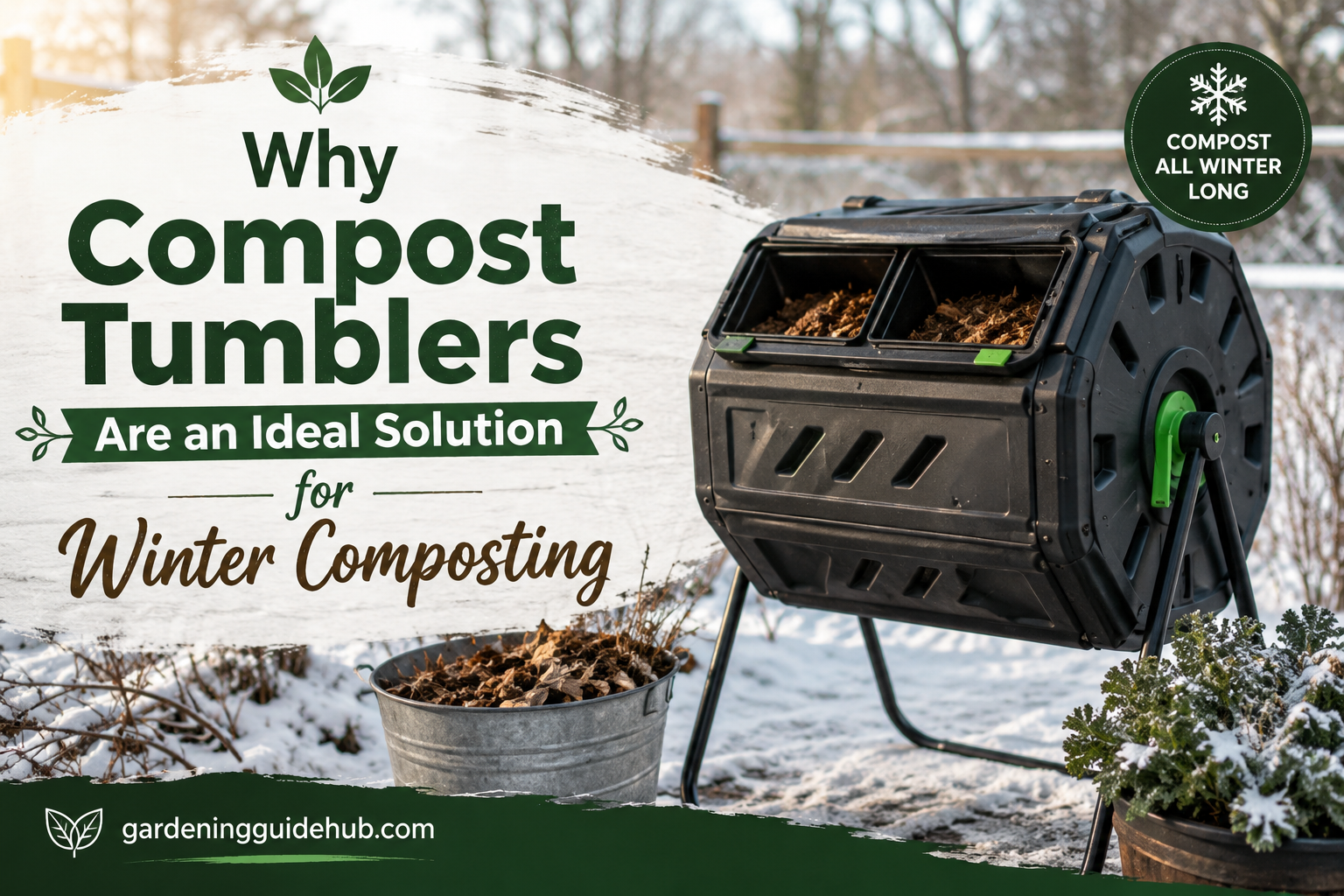
A compost tumbler is essentially an enclosed drum, usually made of plastic or metal, mounted on a frame or axis so it can be rotated. Instead of turning your pile with a pitchfork or shovel, you simply spin the drum using a handle or crank.
That simple design difference changes everything about how the compost behaves, especially in cold weather. Here’s a quick side by side comparison of tumblers versus traditional open piles during winter. 📊
| Feature 🔧 | Compost Tumbler 🛢️ | Traditional Open Pile 🌾 |
|---|---|---|
| Insulation from cold | Enclosed drum retains heat | Fully exposed to wind and frost |
| Turning in snow or ice | Easy, just crank the handle | Difficult and messy with a fork |
| Moisture control | Sealed design limits snow melt seepage | Prone to soaking from rain or melting snow |
| Pest access | Sealed, rodents and pests kept out | Open access for animals |
| Speed of decomposition | Faster due to consistent aeration | Slower, especially in cold months |
| Effort required | Minimal, mostly rotating | Physically demanding, especially in winter |
As you can see, the enclosed structure alone gives tumblers a major head start when the mercury drops.
🔄 How Tumblers Keep the Heat In
One of the biggest advantages of a compost tumbler is that it acts like a mini greenhouse for your organic waste. The solid outer shell traps warmth generated by the decomposition process instead of letting it escape into the surrounding air. Even on a cold day, the inside of an active tumbler can stay noticeably warmer than the air temperature outside.
That trapped heat matters enormously. Remember, decomposition depends on microbial activity, and microbes thrive in warmth. By holding onto the heat produced during the breakdown of nitrogen rich materials, a tumbler creates a more stable internal climate, one that’s far less likely to freeze solid the way an exposed pile might.
Turning also plays a huge role here. Every time you rotate the drum, you’re mixing the material and reintroducing oxygen throughout the pile. This process, called aeration, feeds the aerobic bacteria responsible for breaking everything down. More oxygen circulating through the mix generally means faster decomposition and, as a nice side effect, more consistent heat generation.
Compare that to a frozen open pile where turning is a genuine workout involving a pitchfork, frozen chunks, and possibly frostbitten fingers. With a tumbler, you just give the handle a few good spins and you’re done. 💪
💧 Moisture Control Is a Winter Game Changer
Cold weather doesn’t just bring low temperatures, it also brings snow, sleet, and freezing rain, all of which can seriously mess with your compost’s moisture balance. Too much water reduces the oxygen available inside the pile since water fills the air pockets microbes need to breathe. Less oxygen means slower decomposition and a higher risk of your pile turning into a smelly, anaerobic mess.
Traditional open piles are basically at the mercy of the weather. Snow melts into the pile, rain soaks through, and unless you’re covering it religiously with a tarp, moisture levels can swing wildly. A compost tumbler sidesteps this problem almost entirely thanks to its enclosed design. Since the drum is sealed, external moisture from snow or rain generally can’t get in unless you intentionally add water yourself.
This level of control is especially valuable in winter, when you want to manage moisture carefully rather than let nature dictate it. If your mix feels too dry, you can add a bit of water directly. If it’s too wet, you can toss in dry carbon rich material like shredded cardboard, dried leaves, or sawdust to soak up the excess.
🍁 Getting the Carbon to Nitrogen Ratio Right
Successful composting, especially in winter, comes down to balance. The relationship between carbon rich materials (often called browns) and nitrogen rich materials (often called greens) drives the whole chemical process that generates heat.
Browns include things like: 🍂 Dried leaves 📦 Shredded cardboard and paper 🪵 Wood chips and sawdust 🌾 Straw
Greens include things like: 🥕 Vegetable and fruit scraps ☕ Coffee grounds 🌿 Fresh grass clippings 🥚 Eggshells
For active, hot composting, which is what you want during winter to keep temperatures up, aim for a carbon to nitrogen ratio somewhere around 25 to 30 parts carbon to 1 part nitrogen. This ratio tends to generate more internal heat than the higher carbon ratios used for slower, cold composting methods.
Since tumblers make mixing so easy, they’re perfectly suited to hot composting. A quick spin after adding new material blends everything together evenly, helping you maintain that ideal ratio without much fuss.
✂️ Why Particle Size Matters More in Winter
Here’s a tip that often gets overlooked: the smaller your material, the faster it breaks down. This is true year round, but it becomes especially important in winter when the cold is already working against you.
Smaller pieces have more surface area exposed to the microbes doing the actual decomposing. Big chunks of cardboard or whole vegetable scraps take much longer to break down than the same material chopped or shredded into smaller bits. In cold conditions, giving your microbes every possible advantage helps offset the slower pace caused by lower temperatures.
Before adding anything to your tumbler, take a few extra minutes to chop up kitchen scraps, shred paper and cardboard, and break down any larger yard waste. It’s a small step that pays off with noticeably faster results, even in the depths of winter. ✂️
🌀 Turning Frequency and Air Circulation
Oxygen is the fuel that keeps aerobic microbes alive and working. Without enough of it, decomposition slows or shifts toward anaerobic processes, which tend to smell unpleasant and work far less efficiently.
In a traditional pile, getting enough oxygen into the mix during winter means physically turning frozen, heavy material with a fork, a task that’s uncomfortable at best and genuinely difficult at worst. Tumblers eliminate this barrier entirely. A quick rotation, done every couple of days, keeps oxygen flowing throughout the material without any real physical strain.
🥶 Can Compost Tumblers Freeze Solid?
It’s a fair question, and the honest answer is that in extremely cold conditions, the mechanism itself (the axle or bearings) could potentially stiffen up or freeze if it’s not well maintained. If that happens, a hair dryer applied to the frozen joint is usually enough to loosen things up again.
That said, the compost material inside a well managed, actively turned tumbler rarely freezes completely solid the way an untouched open pile might. The combination of insulation, trapped heat from decomposition, and regular turning generally keeps the internal temperature well above what you’d find outside, even during a cold snap.
📦 Batch Control Keeps Things Moving
One habit that can slow down any composting system, tumblers included, is constantly adding fresh material to a batch that’s already partway through decomposing. Every time you toss in new scraps, you shift the carbon to nitrogen balance and effectively restart part of the process.
The better approach, especially with a tumbler, is to build batches. Fill your tumbler with a well balanced mix, then let that batch run its course without adding anything new until it’s finished. Managed properly, most tumblers can produce usable finished compost in around three months, even through winter. Once a batch is done, empty it out and start the next one.
If you’re generating kitchen scraps daily and don’t want to wait, consider using a small holding bin or a second tumbler to collect new material while your first batch finishes up.
🧊 Insulation: The Tumbler’s Secret Weapon
Traditional composting in winter usually requires extra insulation efforts, wrapping the pile in tarps, surrounding it with straw bales, or building an enclosure out of insulating material like polystyrene. Even then, there’s always a risk of moisture getting in every time you uncover the pile to turn it.
Quality compost tumblers largely solve this problem by design. The enclosed drum acts as natural insulation, and because it’s a sealed unit, there’s no need to expose the compost to the elements just to turn it. You get the insulating benefits without the extra setup work traditional piles require. 🧣
✅ Quick Tips for Winter Tumbler Composting
Here’s a simple checklist to help you get the most out of your tumbler during the colder months:
🔹 Position your tumbler somewhere that gets sunlight during the day, even in winter, to add a little extra warmth. 🔹 Maintain a carbon to nitrogen ratio close to 25 to 30 parts carbon to 1 part nitrogen for faster, hotter composting. 🔹 Chop or shred materials into small pieces before adding them. 🔹 Turn the tumbler every couple of days to keep oxygen circulating. 🔹 Avoid constantly adding fresh scraps to an active batch, build batches instead. 🔹 Check moisture levels regularly and adjust with water or dry browns as needed. 🔹 If the mechanism seems stiff from cold, warm it gently with a hair dryer rather than forcing it.
🌸 Setting Yourself Up for Spring
Perhaps the best reason to keep composting through winter is what it sets you up for come spring. Instead of starting from scratch when the weather warms, you’ll have rich, finished compost ready to work into garden beds, raised planters, or containers right when planting season begins.
Alternative winter composting methods exist, vermicomposting with worms being one popular option, but these often require careful management or a genuine interest in caring for worm colonies indoors. A compost tumbler offers a far more straightforward path. It lets you follow essentially the same process you’d use any other time of year, just with a bit more attention paid to insulation, moisture, and your carbon to nitrogen ratio.
❓ Common Questions About Winter Tumbler Composting
Is it normal for the tumbler to steam when I open it in winter? 💨 Yes, and it’s actually a great sign. Steam rising from the drum when you open the lid means the internal temperature is significantly higher than the outside air, which tells you the microbes are active and working hard. Seeing steam on a cold morning is one of the clearest signals that your composting process is healthy.
Should I feed my tumbler less often in winter? 🍽️ It’s usually a good idea to slow down how often you add fresh material once temperatures drop. Since decomposition naturally takes a bit longer in the cold, giving each batch more time to break down before adding anything new helps maintain a more stable internal environment and better heat retention.
Can I still use a compost tumbler if I live somewhere with harsh winters? 🏔️ Absolutely. Gardeners in genuinely cold climates can still use tumblers successfully, though it helps to place the unit in a sheltered spot, such as near a wall or fence that blocks the worst of the wind, and to pay closer attention to insulation and batch size. Some gardeners even wrap their tumbler in an old blanket or moving pad during the coldest stretches for extra protection.
What if my compost smells bad during winter? 👃 An unpleasant smell almost always points to too much moisture or not enough oxygen circulating through the mix. Try adding more dry, carbon rich material like shredded cardboard or dried leaves, and turn the tumbler a bit more frequently until the smell clears up.
🏆 Final Thoughts
So, do compost tumblers really work in winter? Based on how they’re designed and how they function, the answer is a confident yes. Between their enclosed structure that traps heat, their sealed design that keeps out excess snow and rain, and how easy they make turning and aerating your material, tumblers solve most of the headaches that come with cold weather composting.
If you already own a tumbler, there’s no real reason to let it sit idle once the temperature drops. With a bit of attention to your carbon to nitrogen ratio, particle size, and turning frequency, you can keep producing quality compost right through the winter months, and have a fresh batch ready just in time for spring planting. 🌷🪴