Standing in front of a wall of AeroGarden boxes, or scrolling through three nearly identical looking product listings online, is enough to make anyone’s head spin. They all promise fresh herbs, crisp lettuce, and homegrown vegetables without soil, without sunlight, and without much effort. But the Harvest, Bounty, and Farm are not interchangeable, and picking the wrong one can mean either an underwhelming little gadget or a countertop monster that never lives up to its potential.
This guide breaks down exactly how these three AeroGarden families differ, what each one actually does well, and which model fits your kitchen, your cooking habits, and your patience level. By the end, you should have a clear answer instead of another browser tab left open indefinitely. 🛒
📝 A quick note before we dive in: AeroGarden’s ownership changed hands in the past couple of years, and the lineup has shifted a bit as a result. The Harvest and Bounty families remain the most consistently available and well supported models, while Farm availability has been less predictable at times. It’s worth checking current stock and warranty terms before buying, especially if you’re eyeing a Farm model.
📊 The Quick Comparison Table
Before getting into the details, here’s a side by side snapshot of what each family offers. 👇
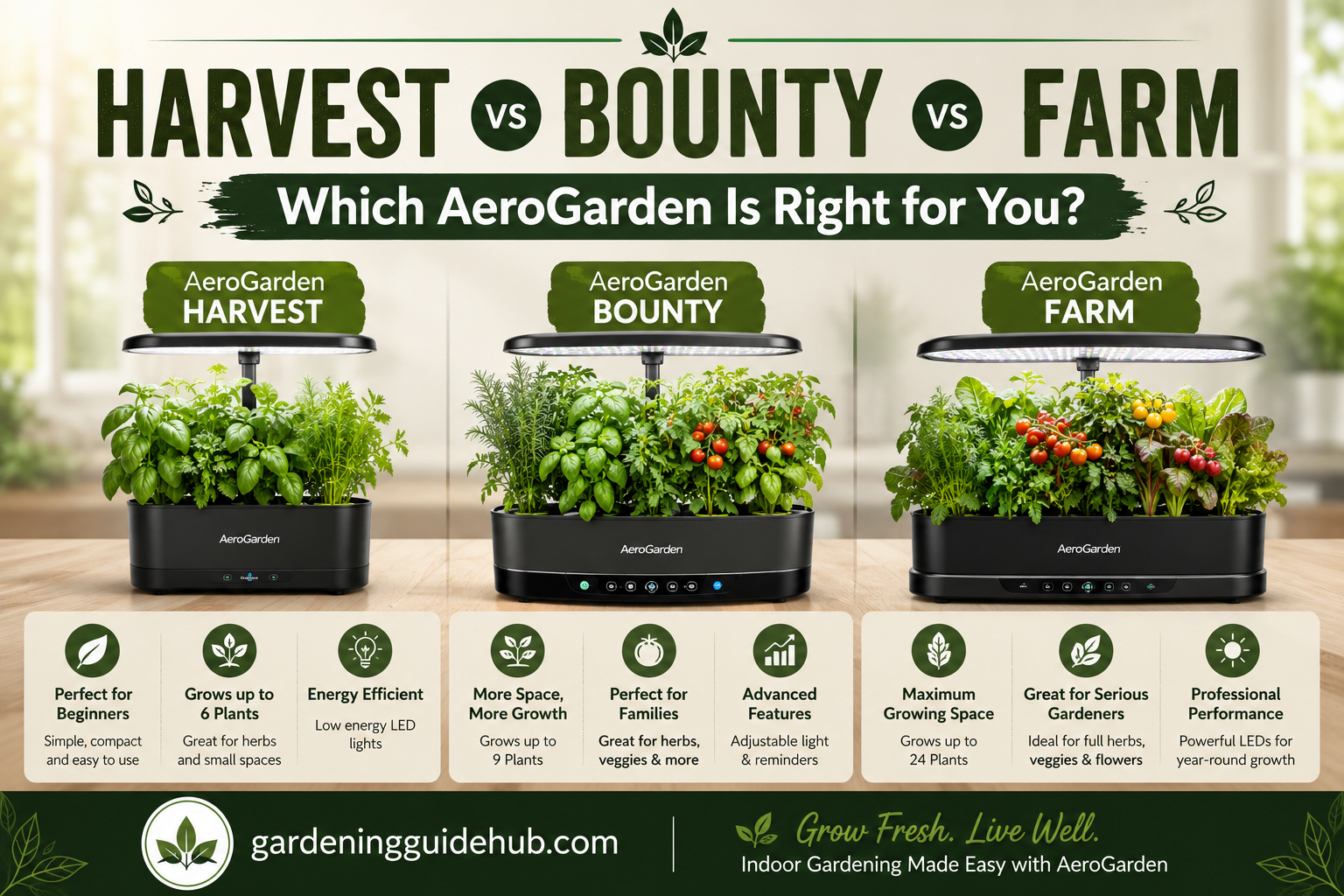
| Feature 🔍 | Harvest 🌱 | Bounty 🍅 | Farm 🌾 |
|---|---|---|---|
| Pod capacity | 6 plants | 9 plants | 12 to 24 plants |
| Max grow height | 12 to 18 inches | Up to 24 inches | Up to 36 inches |
| Light power | 20W LED | 30 to 50W LED | 60W per 12 pod section |
| Water reservoir | Around 0.7 gallons | Around 1.1 gallons | 2 or more gallons per section |
| Ideal placement | Small countertop corner | Dedicated counter space | Floor standing furniture piece |
| Smart features | Basic reminders and timer | Touchscreen, WiFi, vacation mode | Touchscreen, WiFi, modular stacking |
| Best suited for | Beginners and herb lovers | Home cooks wanting real produce | Serious indoor growers |
Think of this table as your cheat sheet for the rest of the article. Everything below expands on why these numbers actually matter in real kitchen life.
🌿 The Harvest: A Gentle Introduction to Hydroponics
The Harvest is the smallest of the three families, and it’s built for people who want fresh herbs without committing much counter space, money, or mental energy to the process. With six pods and a growing height capped around a foot (a bit more on the XL version), it’s roughly the footprint of a small coffee maker.
🌱 What It Handles Well
This is where the Harvest genuinely shines. Basil, mint, parsley, cilantro, dill, and thyme all thrive under that 20 watt light, and because hydroponic growth tends to outpace soil grown plants considerably, you’re often snipping fresh herbs within four to five weeks of planting. Compact lettuce and salad greens also do well here, giving you a rotating supply of fresh leaves for sandwiches and salads.
⚠️ Where It Falls Short
The Harvest’s low ceiling is a genuine limitation, not just a minor inconvenience. Plants that naturally grow tall, like full sized tomatoes or peppers, will hit the light panel long before they’re ready to fruit. You can technically plant them, but don’t expect much of a harvest. The smaller water tank also means more frequent refilling once plants mature and start drinking heavily.
👍 Who Should Buy One
🔹 First time hydroponic gardeners who want a low pressure way to test the waters 🔹 Anyone who mostly cooks with fresh herbs rather than full vegetables 🔹 Small kitchens, apartments, or dorms with limited counter space 🔹 Gift buyers looking for something approachable for a beginner
🍅 The Bounty: The Middle Ground That Actually Grows Vegetables
The Bounty steps things up considerably. With nine pods and up to two feet of grow height, this is the model where people start feeling like they’re running an actual mini farm rather than a herb box.
💪 The Performance Jump
The light output roughly doubles or more compared to the Harvest, depending on whether you choose the standard or Elite version. That extra power translates directly into what you can grow. Cherry tomatoes actually ripen. Compact pepper varieties produce real peppers instead of flowers that drop before fruiting. Leafy greens like kale and chard have enough vertical room to develop properly.
The larger reservoir also means less frequent refilling, and features like vacation mode can slow growth temporarily if you’re away for a week, so you’re not coming home to wilted plants.
📏 The Space Trade Off
This isn’t a discreet countertop appliance anymore. Fully extended, the Bounty needs roughly two feet of vertical clearance, which rules out tucking it under most upper kitchen cabinets. It wants a dedicated spot, whether that’s an island, an open counter stretch, or a nearby table.
🧽 A Practical Downside Worth Knowing
Cleaning between plantings is more involved than with the Harvest. Nine root systems tangled together in a larger bowl take real effort to separate and clean out, so budget a bit of patience for that part of the process.
👍 Who Should Buy One
🔹 Home cooks who want actual vegetables, not just garnish herbs 🔹 Anyone with a dedicated counter or island space to spare 🔹 Gardeners ready to spend a bit more for meaningfully more output 🔹 People who want smart features like app reminders and vacation mode
🌾 The Farm: Indoor Farming for the Truly Committed
The Farm family exists in a different category altogether. These are floor standing units, sized more like furniture than kitchen appliances, designed for growing large quantities of food indoors year round.
🚜 Serious Scale, Serious Output
With 12 to 24 pod capacity, 60 watt lighting per section, and grow heights reaching up to three feet on the larger models, the Farm can handle full size tomatoes, proper bell peppers, cucumbers, and even continuous rotating batches of herbs at commercial like volume. Some owners run their Farm units as a genuine side source of fresh produce for their household, harvesting enough to noticeably cut down grocery trips.
Modular stacking is also an option with certain Farm models, letting ambitious growers build a taller, wall like setup for maximum output in a smaller footprint.
🏋️ The Commitment Involved
This scale of growing isn’t passive. With a dozen or more plants growing simultaneously, regular pruning, harvesting, and general upkeep becomes closer to a hobby that demands consistent attention rather than something you check on once a week. The reservoir holds multiple gallons per section, so deep cleaning between plantings is a genuinely bigger task than with the smaller families.
Cost is another factor. Farm units sit well above Harvest and Bounty pricing, and given some uncertainty around ongoing availability in recent years, it’s worth double checking current stock, warranty terms, and pod availability before investing in one.
👍 Who Should Buy One
🔹 Growers with a dedicated floor space, like a sunroom corner or basement area 🔹 Households that cook with fresh produce daily and want to grow a meaningful portion of it 🔹 Anyone who already outgrew a Bounty and wants significantly more capacity 🔹 People genuinely excited about treating indoor growing as a serious hobby, not a passive gadget
🥗 What to Actually Grow in Each Model
Marketing copy tends to say “herbs and vegetables” without much nuance, so here’s a more specific breakdown.
In the Harvest 🌱 Great choices include basil, mint, parsley, cilantro, dill, chives, and compact lettuce or arugula. Dwarf cherry tomato varieties can work if you’re willing to prune aggressively, but skip peppers and cucumbers entirely, there simply isn’t enough height or light power to support them properly.
In the Bounty 🍅 Everything the Harvest grows, plus productive cherry tomato varieties, compact pepper types like mini bells or jalapeños, slim eggplant varieties, kale, chard, and even bush style cucumbers with a bit of support. Mixing taller plants toward the back pods and shorter herbs up front helps everything get adequate light.
In the Farm 🌾 Full size tomatoes, proper bell peppers, vining cucumbers, strawberries, and even broccoli or cauliflower become realistic options. Avoid root vegetables since there’s no soil depth for them to develop, and skip sprawling vines like pumpkins or corn, which simply aren’t suited to this style of growing regardless of available space.
🏡 Matching the Model to Your Actual Lifestyle
Choose the Harvest if your kitchen space is limited, you mainly want fresh herbs to elevate everyday cooking, and you’d rather ease into hydroponic gardening than dive in headfirst.
Choose the Bounty if you cook regularly, have a bit of dedicated counter space, and want to grow real vegetables alongside your herbs without committing to a full scale setup.
Choose the Farm if you have genuine floor space to spare, you’re serious about growing a substantial portion of your household’s fresh produce, and you’re ready to treat indoor gardening as an active, ongoing hobby rather than a low maintenance appliance.
🌟 Getting Started: What the First Few Weeks Look Like
Whichever model you choose, the early experience follows a similar pattern. During the first one to two weeks, you’re mostly waiting for germination, herbs typically emerge within seven to ten days, while fruiting plants like tomatoes can take up to two weeks longer. It’s normal to feel like nothing is happening during this stretch.
From roughly week three onward, growth accelerates noticeably, and this is usually when new owners get genuinely excited watching seedlings develop day by day. By week six or seven in a Harvest, or a bit later for fruiting plants in a Bounty or Farm, you’ll be harvesting your first real yield.
A few practical tips make this early period smoother. Starting with forgiving herbs like basil or mint builds confidence quickly. Pruning regularly, even when it feels counterintuitive, actually encourages fuller, more productive growth. And keeping a simple log of what you planted and how it performed helps you fine tune future plantings.
❓ Common Questions About Choosing an AeroGarden
Can I upgrade from a Harvest to a Bounty later instead of buying big right away? ⬆️ Absolutely, and many owners do exactly this. Starting with a Harvest is a low risk way to learn the rhythm of hydroponic growing, adding water and nutrients on schedule, pruning regularly, understanding how light height affects growth, before investing more money into a larger system. The skills transfer directly, so nothing you learn on a Harvest goes to waste if you upgrade later.
Do these systems need direct sunlight or a specific room? ☀️ No, and that’s actually one of the biggest advantages of the AeroGarden system. The built in LED lighting supplies everything the plants need, so placement is based on counter or floor space and access to a power outlet rather than window exposure. That said, keeping units away from major temperature swings, like right next to a drafty window or a heat vent, helps growth stay consistent.
How noisy are these systems while running? 🔇 Very quiet. The internal pump that circulates water runs on a low, steady hum that most people barely notice after the first day or two. It’s nowhere near loud enough to disrupt sleep or conversation, even in a small studio apartment.
Is it normal for some pods to grow faster than others in the same unit? 🌱 Yes, this is completely normal and comes down to differences between plant varieties rather than anything wrong with the machine. Basil and mint, for example, are notoriously fast growers, while peppers and tomatoes take longer to establish before they really take off.
What happens if I forget to add water or nutrients on schedule? ⏰ All three families include reminder systems, ranging from simple blinking lights on the Harvest to app notifications on WiFi connected Bounty and Farm models, specifically to prevent this. Missing a scheduled refill by a day or two typically isn’t a major problem, but consistently ignoring reminders will slow growth and can eventually stress the plants.
💵 Thinking About Long Term Cost, Not Just the Sticker Price
The upfront price is only part of the picture. Ongoing costs come mainly from seed pods and plant food, and these scale with pod capacity. A Harvest owner replacing herb pods every few months spends relatively little, often just a few dollars per pod. A Bounty or Farm owner running through nine, twelve, or twenty four pods multiple times a year will naturally spend more, though many gardeners offset this by reusing the included baskets with their own seeds instead of buying pre seeded replacement pods every time.
It’s also worth factoring in what you’re replacing. A household that regularly buys fresh herbs, salad greens, or specialty produce like heirloom tomatoes at premium grocery prices may find that a Bounty or Farm pays for itself faster than expected, particularly once you count the convenience of never needing a last minute grocery run for a sprig of basil.
🏁 Final Thoughts
There’s no single “best” AeroGarden, only the one that actually fits your space, your cooking habits, and how much hands on involvement you want from your indoor garden. The Harvest rewards simplicity and small spaces. The Bounty hits a genuinely useful middle ground between manageable size and real vegetable output. The Farm delivers serious volume for anyone ready to treat growing food indoors as a proper hobby rather than a countertop novelty.
Whichever one ends up on your counter or in your corner, the payoff is the same either way: snipping fresh basil or picking a ripe cherry tomato in the middle of winter, grown entirely indoors, without a single trip to the grocery store’s produce aisle. 🌿🍅