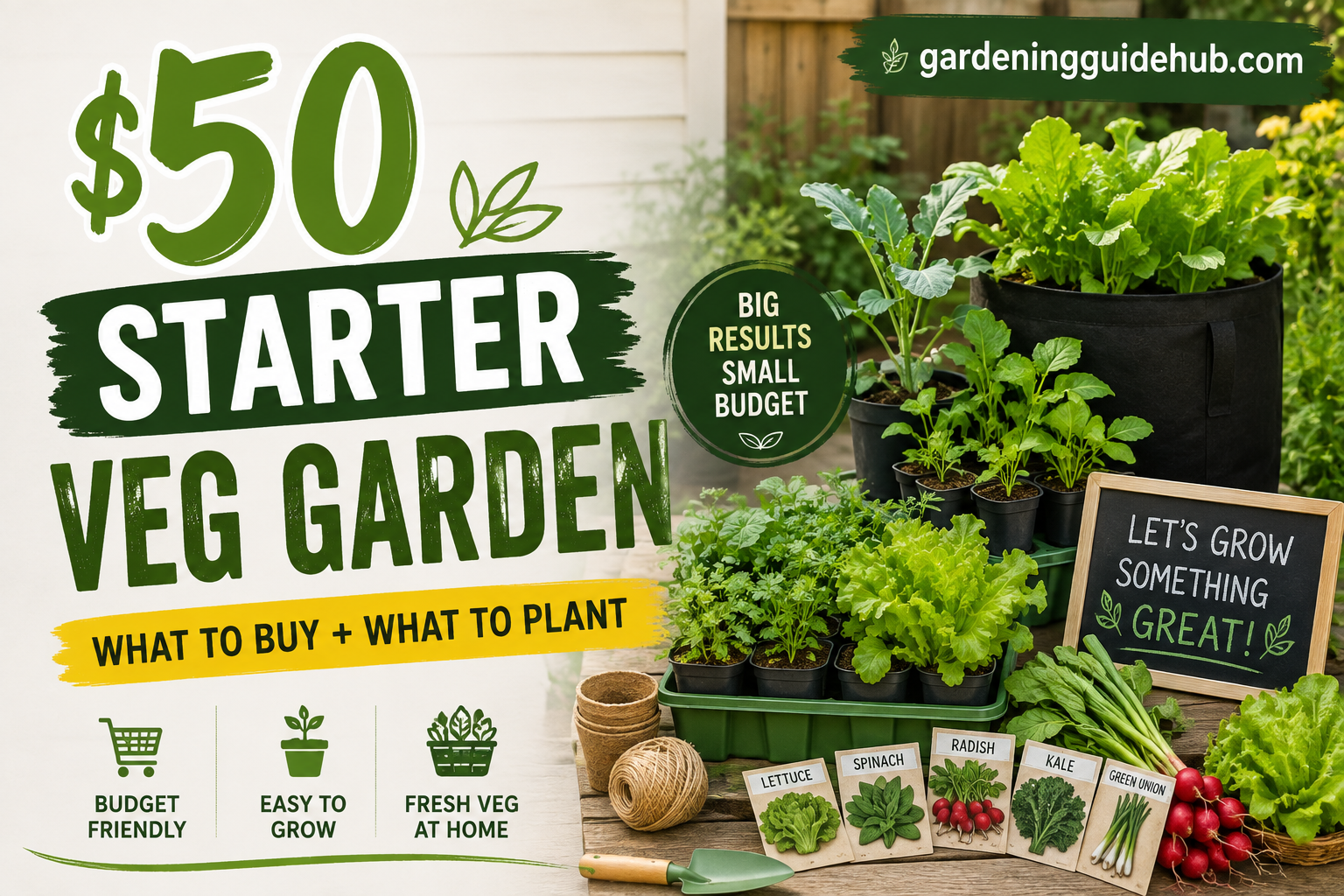
You don’t need a fancy greenhouse, raised cedar beds, or a truckload of gadgets to start growing your own food. Honestly, one of the best gardens I ever grew came together with a pile of secondhand containers, a bag of soil, and a handful of seed packets that together cost less than a nice dinner out. If you’ve been putting off starting a vegetable garden because you think it requires a big investment, this guide is here to prove that a $50 budget can absolutely get you a real, productive garden.
Below we’ll break down exactly what to buy, how to spend that $50 wisely, which vegetables give you the best return for your money, and how to set everything up so it actually thrives instead of fizzling out in July. Let’s dig in. 🛒🌿
Why a Budget Garden Actually Works Better 💡
There’s a myth that spending more money guarantees a better garden. In reality, an oversized budget often leads to overbuying: too many tools you’ll never touch, fancy raised beds before you even know if you enjoy gardening, and specialty seeds for vegetables you don’t even like to eat. A tight budget forces smart choices, and smart choices are exactly what a beginner garden needs.
Here’s the good news: vegetables are naturally cheap to grow. A $3 packet of seeds can produce dozens of plants worth $30 or more at the grocery store. That means your $50 isn’t just a starting cost, it’s an investment that pays for itself within a single growing season.
The $50 Budget Breakdown 🧮
Let’s get specific. Here’s a sample breakdown of how to spend $50 on a starter vegetable garden, assuming you’re starting from scratch with no tools or containers.
| Item 🛠️ | Estimated Cost | Notes |
|---|---|---|
| Potting soil or garden soil (2 bags) | $12 | Look for an all purpose mix with compost already blended in |
| Containers or a small raised bed kit | $15 | Buckets, grow bags, or a used container work just as well as new ones |
| Seed packets (5 to 6 varieties) | $10 | Choose fast growing, high yield vegetables |
| Basic hand trowel | $5 | One tool is enough to start |
| Organic fertilizer (small bag) | $6 | A slow release granular fertilizer lasts all season |
| Miscellaneous (twine, plant markers, gloves) | $2 | Optional but handy |
| Total | $50 | Room to swap items based on what you already own |
If you already have a trowel, gloves, or containers lying around, that frees up more money for seeds, soil, or a small trellis. The beauty of this budget is how flexible it is.
What to Buy: The Essentials 🧰
1. Soil 🪴
This is where you should never cut corners, even on a tight budget. Cheap, low quality soil compacts easily, drains poorly, and lacks nutrients, which means your plants will struggle no matter how good your seeds are. Spend a little extra here if you need to trim the budget somewhere else.
Look for a bag labeled “all purpose potting mix” or “raised bed soil” with compost or organic matter already included.
2. Containers 🪣
You genuinely don’t need to buy brand new pots. Great budget friendly container options include:
- Five gallon buckets with drainage holes drilled in the bottom
- Grow bags (fabric pots), which are cheap and reusable for years
- Old totes, bins, or even large yogurt tubs for smaller herbs
- A single small raised bed if you have a patch of ground to work with
The goal is simply enough depth (at least 8 to 12 inches for most vegetables) and good drainage.
3. Seeds, Not Seedlings 🌾
Seedlings (the little starter plants sold at nurseries) are convenient but expensive, often $3 to $5 per plant. Seeds cost a fraction of that and give you way more plants per packet. A single $3 packet of lettuce seeds can produce 40 or more plants over a season.
4. One Good Tool 🔧
You don’t need a full tool shed. A hand trowel handles planting, transplanting, and light weeding. If your budget allows, a small hand fork is a nice second tool, but it’s not essential for a first season.
5. Fertilizer 🌾
Even good potting soil runs out of nutrients after 6 to 8 weeks. A small bag of organic, slow release fertilizer keeps your plants fed through the whole season without needing to buy anything else.
What to Plant: Best Vegetables for a Budget Garden 🥕🍅
The trick to a $50 garden isn’t just spending less, it’s choosing vegetables that give you the biggest harvest for the smallest investment. Here’s a table of the best budget friendly vegetables, all chosen for being cheap to start, fast to grow, and generous with their yield.
| Vegetable 🌱 | Seed Cost | Days to Harvest | Why It’s a Great Budget Pick |
|---|---|---|---|
| Lettuce 🥬 | $2 to $3 | 30 to 50 days | Cut and come again harvesting means one planting feeds you for weeks |
| Green beans 🫘 | $2 to $3 | 50 to 60 days | Extremely high yield per seed, easy to grow |
| Radishes 🔴 | $2 | 20 to 30 days | Ready in under a month, great for beginners |
| Zucchini 🥒 | $3 | 45 to 55 days | A single plant can produce more squash than one household can eat |
| Tomatoes 🍅 | $3 (or a $2 seedling) | 60 to 85 days | Worth the slightly higher cost for the huge grocery savings |
| Peppers 🫑 | $3 | 60 to 90 days | Slow to start but very productive once established |
| Herbs (basil, cilantro, parsley) 🌿 | $2 each | 25 to 60 days | Small investment, big flavor payoff |
| Peas 🟢 | $2 to $3 | 55 to 70 days | Great for vertical growing, doesn’t need much space |
| Kale 🥗 | $2 | 50 to 65 days | Keeps producing for months, very low maintenance |
| Green onions 🧅 | $2 | 60 to 80 days | Can even be regrown from kitchen scraps to save more money |
If you’re picking just five or six to start, a great budget combo is lettuce, green beans, radishes, zucchini, and one tomato plant. That mix gives you fast harvests (radishes and lettuce), a heavy producer (zucchini and beans), and a summer favorite (tomatoes) all season long.
Sample $50 Garden Plan 🗺️
Here’s how that budget might play out in an actual small garden space, using containers or a compact raised bed.
| Container/Space | Plant | Approximate Cost |
|---|---|---|
| 5 gallon bucket #1 | Tomato (1 plant) | $2 |
| 5 gallon bucket #2 | Zucchini (1 plant) | $1 |
| Grow bag #1 | Green beans (a handful of seeds) | $1 |
| Grow bag #2 | Peppers (1 to 2 plants) | $2 |
| Shallow container | Lettuce (mixed variety) | $1 |
| Shallow container | Radishes | $1 |
| Small pot | Basil | $1 |
| Small pot | Parsley | $1 |
That’s roughly $10 in seeds, leaving the rest of your $50 for soil, containers, a trowel, and fertilizer as outlined earlier.
Money Saving Tips to Stretch Your $50 Even Further 💰
Start seeds indoors in recycled containers. Egg cartons, yogurt cups, or toilet paper rolls all work as free seed starting pots.
Swap seeds with friends or neighbors. Seed packets usually contain far more seeds than one small garden needs, so trading extras is a great way to diversify your garden for free.
Save seeds from what you grow. Tomatoes, beans, and peppers all produce seeds you can dry and replant next season, meaning your $50 garden basically pays for next year’s garden too.
Use kitchen scraps. Green onions, celery, and lettuce bases can regrow in a cup of water before being transplanted into soil.
Check community programs. Many towns have seed libraries, community garden plots, or free compost programs through the local municipality.
Compost your own kitchen waste. Skip buying fertilizer altogether after the first season by starting a simple compost bin with vegetable scraps and yard waste.
Setting Your Budget Garden Up for Success ✅
Buying the right materials is only half the job. Here’s how to make sure your $50 investment actually turns into a full season of harvests.
Pick a sunny spot. Most of the vegetables listed above need at least 6 hours of direct sun. Even great soil and seeds won’t perform well in deep shade.
Water consistently. Containers dry out faster than ground soil, so check them daily during hot weather. A finger test (an inch into the soil) tells you if it’s time to water.
Don’t overcrowd. It’s tempting to cram in every seed packet you bought, but overcrowded plants compete for nutrients and light, which lowers your overall harvest. Follow the spacing guide on the seed packet.
Succession plant fast growers. Since radishes and lettuce mature quickly, replant a new batch every couple of weeks to keep a steady harvest going instead of one big flush followed by empty containers.
Keep notes. Jot down what worked, what didn’t, and what you’d buy again. This turns your $50 garden into an even smarter, cheaper garden next season.
Common Mistakes That Waste Your Budget 🚫
- Buying too many tools upfront. One trowel is enough for a first season, extra gadgets can wait.
- Choosing seedlings over seeds when money is tight. Seedlings are convenient but cost far more per plant.
- Skimping on soil quality. Cheap, poor quality soil leads to weak plants no matter how much you spend elsewhere.
- Overbuying seed packets. A handful of well chosen vegetables beats a scattered pile of ten different crops you don’t have room or time for.
- Forgetting drainage holes. Containers without proper drainage lead to root rot, which can wipe out an entire plant overnight.
Frequently Asked Questions ❓
Can I really grow a full vegetable garden for $50? Yes, especially if you already own basic tools or containers. Seeds are inexpensive, and a single seed packet often produces dozens of plants, making $50 go much further than most beginners expect.
Is it better to buy seeds or seedlings on a tight budget? Seeds almost always stretch your budget further. Seedlings are worth the extra cost mainly for slow growing crops like tomatoes and peppers if you’re short on time.
What’s the fastest vegetable to grow for a quick win? Radishes. They’re ready to harvest in as little as 20 days, which makes them a great confidence booster for new gardeners.
Do I need a raised bed, or are containers enough? Containers are completely sufficient for a first season, especially for leafy greens, herbs, and even compact tomato varieties. A raised bed is a nice upgrade later, not a requirement to start.
How can I keep the garden productive without spending more money? Compost kitchen scraps for free fertilizer, save seeds from your harvest for next season, and regrow scraps like green onions in water before planting them in soil.
Final Thoughts 🌻
A vegetable garden doesn’t have to drain your wallet to be worthwhile. With just $50, thoughtful choices, and a sunny spot to work with, you can grow a genuinely productive garden that pays for itself many times over by the time harvest season rolls around. Start with a few reliable, high yield vegetables, reuse what you already have, and let the garden grow from there. Sometimes the smallest budgets grow the biggest confidence, and that’s worth more than any fancy gardening gadget. 🥬🍅✨