
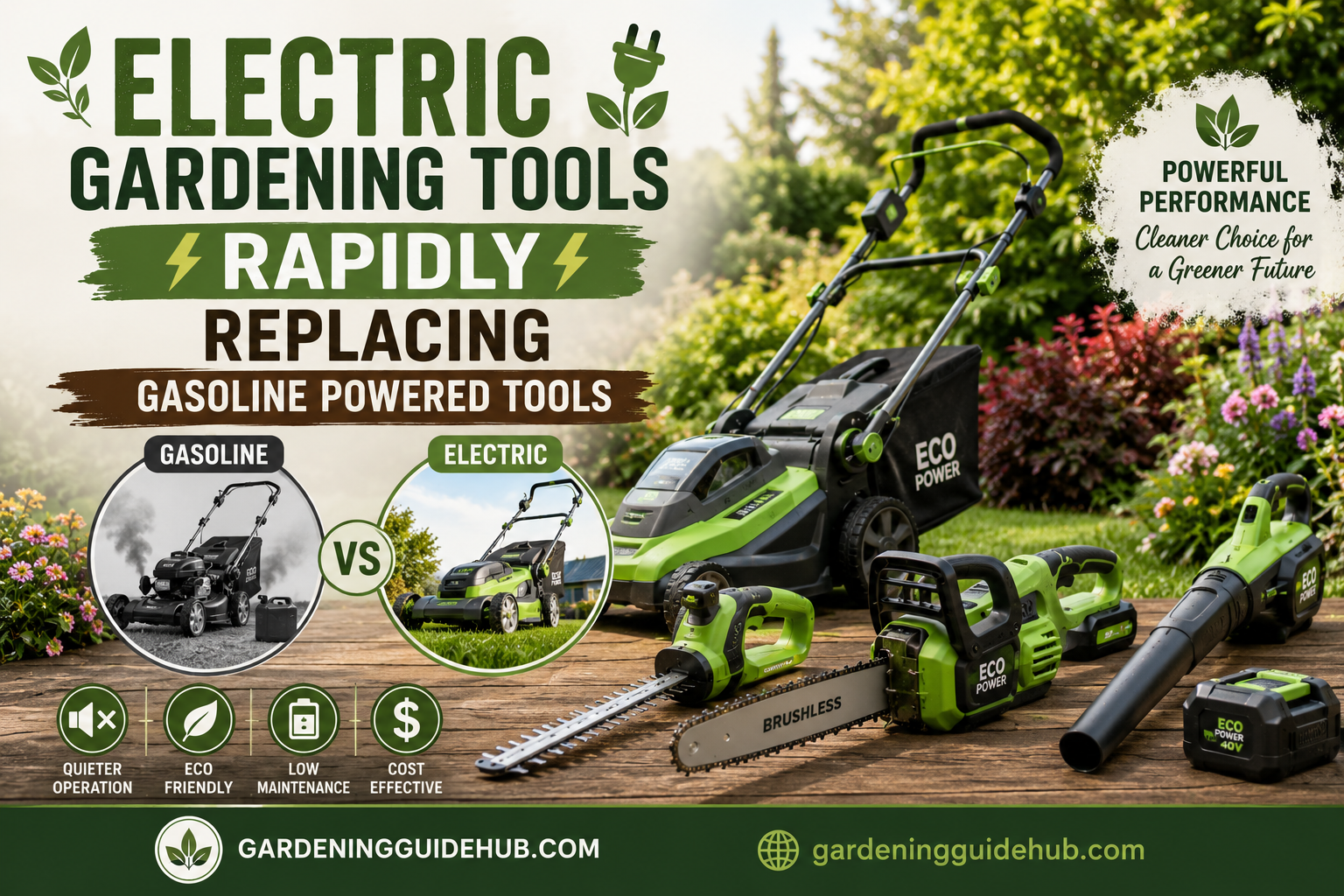
Walk into any garden center or hardware store these days and you’ll notice something has shifted. The wall of gas cans, oil mix bottles, and pull start mowers that used to dominate the outdoor power equipment section has been quietly making room for something else: rows of sleek, battery powered tools charging on display shelves. It’s not your imagination. Electric gardening tools are genuinely taking over, and the shift has been happening faster than most people realize. 🔋
If you’ve been holding onto your gas trimmer or mower out of habit, or you’re simply wondering whether it’s finally time to make the switch, this guide covers everything you need to know about why electric tools are winning over gardeners everywhere, and whether they’re the right choice for your own yard.
📈 Just How Big Is the Shift?
The numbers tell a pretty clear story. Electric and battery powered hand tools now account for more than half of all gardening tools sold, a milestone that would have seemed unlikely just a decade ago when gas powered equipment was still considered the standard for anyone doing serious yard work. Even in categories long dominated by gas engines, like lawn mowers, electric models now make up well over a quarter of total sales and continue climbing every year.
Major manufacturers have taken notice. Companies producing battery powered outdoor equipment have reported strong double digit sales growth in recent years, with demand at times outpacing what retailers can keep in stock. That kind of momentum doesn’t happen by accident. It reflects a genuine change in what everyday gardeners and homeowners are looking for from their equipment.
🌍 Why Gardeners Are Making the Switch
There isn’t just one reason behind this trend, it’s really a combination of factors that have all come together at the same time. Let’s look at what’s actually driving the change.
🔋 Battery Technology Has Finally Caught Up
For years, the biggest knock against electric garden tools was simple: they just weren’t as powerful or long lasting as their gas powered counterparts. A battery trimmer might run out of juice halfway through a yard, or a cordless mower might struggle with thick, overgrown grass.
That’s changed dramatically. Modern lithium ion batteries pack significantly more energy into a smaller, lighter package, and many premium battery tools now rival or even exceed the cutting power of comparable gas models. Runtime has improved too, with many batteries lasting through an average sized yard on a single charge, and swappable battery systems letting you keep working by simply popping in a fresh pack.
🌱 Environmental Awareness Is Growing
A lot of today’s gardeners, particularly younger homeowners, are more conscious of their environmental footprint than previous generations were. Gas powered equipment, especially older two stroke engines found in many trimmers and leaf blowers, produces a surprising amount of pollution relative to their size. Some studies have found that an hour of use with certain gas powered lawn equipment can generate more smog forming emissions than driving a car for a similar amount of time.
Switching to electric tools eliminates tailpipe emissions entirely from the equipment itself, and for gardeners looking to shrink their personal environmental impact, that’s a meaningful selling point.
🔇 Noise Reduction Matters More Than You’d Think
Anyone who has ever been woken up early on a Saturday morning by a neighbor’s gas leaf blower knows exactly why this matters. Gas engines are loud, often uncomfortably so, and prolonged exposure can contribute to hearing damage over time. Electric tools, by comparison, run dramatically quieter, in many cases at a level closer to a vacuum cleaner than a small engine.
This isn’t just a comfort issue either. Noise concerns have become significant enough that several cities and municipalities, including areas within California, have introduced restrictions or outright bans on gas powered leaf blowers, citing noise pollution as a primary concern. As more places consider similar rules, electric tools offer a way to stay ahead of changing regulations rather than scrambling to comply later.
🧰 Less Maintenance, Less Hassle
Gas engines require regular upkeep, oil changes, spark plug replacements, carburetor cleaning, and the seasonal ritual of either draining the fuel or adding stabilizer before storage. Skip these steps and you’re likely to end up with a machine that won’t start when you need it most.
Electric tools sidestep almost all of this. There’s no oil to change, no fuel to mix, and no carburetor to gum up over winter. Maintenance is largely limited to keeping the battery charged and occasionally cleaning debris off the tool itself. For gardeners who’d rather spend their time actually gardening instead of tinkering with small engines, that simplicity is a huge draw.
💪 Easier to Handle
Gas tools tend to be bulkier and heavier thanks to the engine, fuel tank, and associated components. Electric tools, especially battery powered cordless models, are generally lighter and better balanced, making them easier to maneuver, particularly for anyone who deals with fatigue or reduced strength during longer sessions of yard work.
Starting is another factor. Instead of yanking a pull cord repeatedly, sometimes needing several attempts on a cold morning, most electric tools start with the simple press of a button or trigger.
💰 The Price Gap Has Narrowed
Battery powered tools used to carry a hefty price premium over gas equivalents, largely because of the cost of the batteries themselves. As battery production has scaled up and technology has matured, prices have come down considerably, and in some tool categories electric options are now priced right alongside, or even below, comparable gas models. When you factor in the money saved on fuel and maintenance over the tool’s lifetime, the overall cost of ownership often tips further in favor of electric.
⚖️ Electric vs Gas: A Side by Side Comparison
To make the differences easier to visualize, here’s how electric and gas powered garden tools stack up across the factors that matter most to everyday gardeners. 📊
| Factor 🔍 | Electric Tools ⚡ | Gas Powered Tools ⛽ |
|---|---|---|
| Noise level | Quiet, comfortable for early or late use | Loud, often disruptive to neighbors |
| Emissions | None from the tool itself | Produces exhaust and smog forming pollutants |
| Maintenance | Minimal, mostly charging and cleaning | Regular oil, fuel, and spark plug upkeep |
| Startup | Instant, push button or trigger start | Can require repeated pull starts |
| Weight | Generally lighter and easier to maneuver | Heavier due to engine and fuel tank |
| Runtime | Limited by battery charge, improving steadily | Limited only by available fuel |
| Power for heavy duty jobs | Excellent for most residential tasks, improving for commercial use | Still preferred for very large properties or continuous heavy use |
| Upfront cost | Comparable to gas in many categories now | Often similar, though fuel adds ongoing cost |
| Long term cost | Lower due to no fuel and less maintenance | Higher due to ongoing fuel and upkeep |
🛠️ Which Tools Have Made the Switch Most Successfully
Not every category of gardening equipment has transitioned at the same pace. Some tools were quicker to go electric simply because the power demands were easier to meet with battery technology, while others are still catching up. Here’s a general breakdown.
🌿 Trimmers and edgers have become one of the biggest electric success stories. Modern battery trimmers now handle most residential trimming jobs just as well as gas versions, without the fuel smell or vibration.
🍂 Leaf blowers have seen a major shift too, partly driven by noise restrictions in various cities. Battery blowers have improved significantly and are now common even among landscaping professionals for smaller properties.
🌾 Lawn mowers are trickier since they demand more sustained power, but battery powered push mowers and even riding mowers have made huge strides, now regularly handling average sized residential lawns without issue. Larger properties may still lean toward gas for the extended runtime.
✂️ Hedge trimmers and pruning shears have gone electric almost across the board for home use, since the power requirements are relatively modest and precision matters more than raw force.
🪚 Chainsaws remain one of the more divided categories. Battery chainsaws are excellent for occasional yard cleanup and smaller branches, but many professionals doing heavy duty tree work still reach for gas models due to the sustained power and runtime needed.
🤔 Is Electric Right for Your Yard?
While the trend is clearly moving toward electric, that doesn’t necessarily mean it’s the perfect fit for absolutely everyone. A few things are worth thinking through before you make the switch.
If you have a smaller to average sized residential yard, electric tools are very likely to meet all your needs without compromise, and you’ll enjoy the reduced noise, lower maintenance, and simpler operation along the way.
If you manage a large property, do frequent heavy duty work, or need extended continuous runtime without stopping to recharge, gas equipment, or a combination of both types, might still make more practical sense, at least for now as battery technology continues to improve.
It’s also worth considering your local climate and storage situation. Extreme cold can affect battery performance and charge retention, so if you’re in a very cold climate, you may want to keep batteries stored indoors between uses.
🔮 Where This Trend Is Headed
All signs point to this shift continuing rather than slowing down. Battery technology keeps improving year over year, runtime keeps extending, charging keeps getting faster, and prices keep becoming more competitive with traditional gas equipment. Add growing environmental awareness and expanding noise or emissions regulations in more cities, and it’s easy to see why manufacturers are pouring resources into electric product lines rather than gas engines.
For most everyday gardeners, the practical case for electric tools has become difficult to ignore. Quieter operation, simpler upkeep, lighter equipment, and a smaller environmental footprint add up to a genuinely better experience for the vast majority of yard work most people actually do.
✅ Quick Takeaways
🔹 Electric and battery powered tools now make up more than half of all garden hand tool sales. 🔹 Improved battery technology has closed the power gap with gas equipment. 🔹 Environmental concerns and noise regulations are pushing more gardeners toward electric options. 🔹 Maintenance is far simpler with electric tools, no oil, fuel, or spark plugs to worry about. 🔹 Large properties or heavy commercial use may still benefit from gas power, at least for now. 🔹 The long term cost of ownership often favors electric once fuel and upkeep are factored in.
🛒 Tips for Buying Your First Electric Garden Tool
If you’re ready to try switching even just one tool over to electric, a little planning upfront can save you from a frustrating first experience. Here are a few practical tips worth keeping in mind.
🔸 Stick with one battery platform when possible. Most major brands sell trimmers, blowers, mowers, and hedge trimmers that all share the same battery pack. Buying into one ecosystem means you can swap a single battery between multiple tools instead of juggling separate chargers and battery types for each one.
🔸 Pay attention to voltage and amp hours. Higher voltage generally means more raw power, while amp hours indicate how long the battery will last before needing a recharge. For anything beyond light trimming or small yard cleanup, look for tools in the higher voltage ranges paired with a larger amp hour battery.
🔸 Consider buying a spare battery. For larger yards, having a second fully charged battery on hand means you can keep working the moment the first one runs low, rather than waiting around for a recharge.
🔸 Check the warranty and battery lifespan. Batteries do degrade over time with repeated charging cycles, so it’s worth checking how long the manufacturer expects the battery to last and what kind of warranty coverage comes with it.
🔸 Think about storage conditions. Batteries generally prefer moderate temperatures, so avoid leaving them in an unheated shed through a harsh winter or a scorching hot garage in summer, both extremes can shorten battery life over time.
❓ Common Questions About Electric Garden Tools
Do electric tools really have enough power for tough jobs? 💪 For the vast majority of residential yard work, yes. Modern battery tools, particularly those in higher voltage ranges, can handle thick grass, dense hedges, and small to medium branches without much trouble. Only genuinely heavy duty or continuous commercial work still tends to favor gas equipment.
How long do garden tool batteries typically last before needing to be replaced? 🔋 Most quality lithium ion batteries used in garden tools are rated for several hundred charge cycles before their capacity noticeably declines, which for the average homeowner often translates to several years of regular seasonal use before a replacement becomes necessary.
Are corded electric tools still worth considering over battery models? 🔌 Corded tools remain a budget friendly option and never run out of charge mid task, but they do limit your range to how far the cord reaches and can be inconvenient for larger yards. Battery powered models have become popular precisely because they remove that limitation while still offering strong performance.
Can I use electric tools in wet conditions? 🌧️ Most electric garden tools are designed with some degree of weather resistance, but it’s always best to check the manufacturer’s guidance. Generally, working in light dew or slightly damp grass is fine, but you should avoid heavy rain, and battery packs themselves should always be kept dry.
Will switching to electric tools actually save me money over time? 💵 In most cases, yes. While upfront pricing has become fairly comparable between electric and gas options, the ongoing savings from not buying fuel or oil, combined with lower maintenance needs, tend to add up meaningfully over several years of typical use.
🏁 Final Thoughts
The move away from gas powered garden equipment isn’t just a passing trend, it reflects real improvements in battery technology combined with growing demand for quieter, cleaner, and lower maintenance tools. While gas equipment still has its place, particularly for heavy duty or commercial scale work, the vast majority of home gardeners are finding that electric tools now do everything they need, often with less noise, less hassle, and less environmental impact than the gas powered tools they grew up using.
If you’ve been on the fence about switching, there’s rarely been a better time. With prices becoming more competitive and performance continuing to improve, electric gardening tools have moved from a niche alternative to a genuinely mainstream choice, and for most yards, that shift is only going to keep growing. 🌻🔋